Shizuku Official vs Forks, Shizuku-Next, thedjchi 13.7.0 & Shizuku+ Compared
Shizuku official vs forks is the decision every Shizuku user now faces, because the official build has had no release since 25 May 2025 and Android 17 broke it. The forks are not mods or hacks, Shizuku is open source (Apache-2.0), and thedjchi, Shizuku-Next and Shizuku+ are community builds of that same code, with fixes and features the official build does not have.

Written by Omer Akbar, Author & SEO Expert - Fact-checked by Editorial Reviewer, 23 Nov 2026 - How we fact-check
Quick Answer, Shizuku vs Official Forks
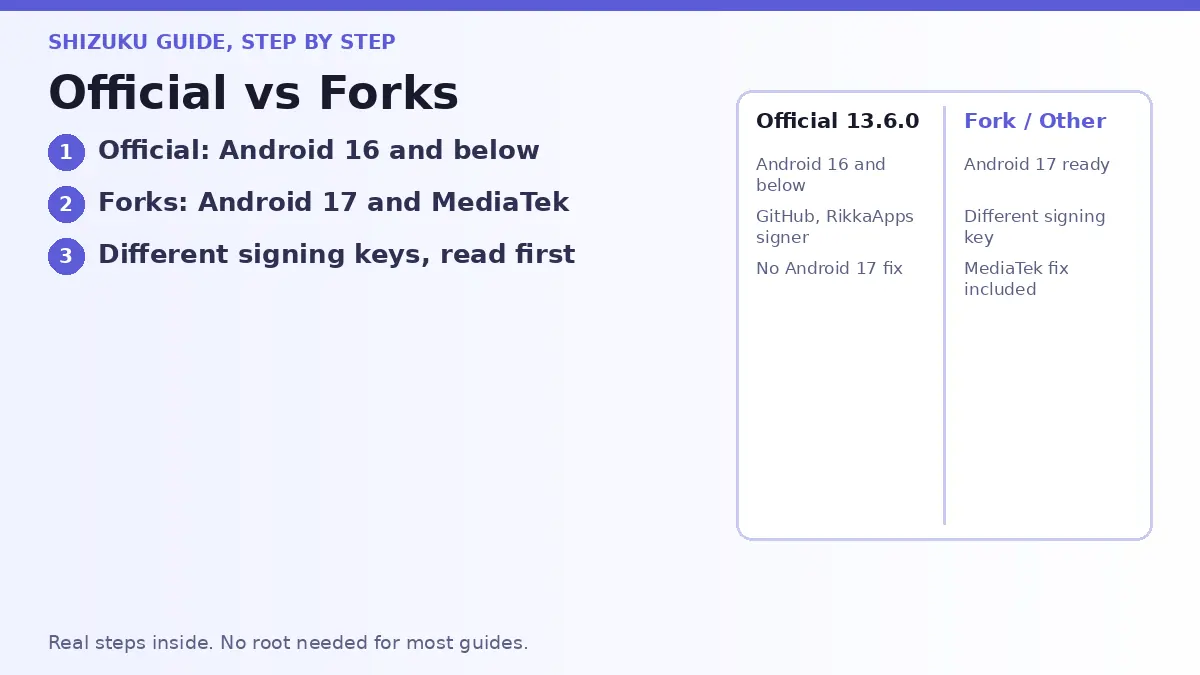
Shizuku vs official forks in one line: official 13.6.0 (r1086) is the stable choice for Android 7.0-16; thedjchi 13.7.0 is the stable-but-paused fork that fixed Android 17 and MediaTek; Shizuku-Next is the actively developed fork with auto-pairing and the newest features; Shizuku+ installs side by side but is verified only by a single secondary source. Forks use a different signing key, uninstall the official build first.
Why forks exist at all
Shizuku is open source under Apache-2.0, so anyone may build and publish their own version of the same code, that is what a fork is. These are not mods, cracks or repacks of the APK; they are separate builds from the public source, signed by their own developers, with their own releases on their own GitHub pages. thedjchi started as a fix build, Shizuku-Next continues that line, and Shizuku+ is a smaller side project.
The reason they matter now is timing. The official project's last release is 13.6.0 on 25 May 2025, and Android 17 broke it, issue #2180, no authorised apps, open since June 2026 with no developer reply at the last check. When the official line pauses and the platform moves, forks are where the fixes land. That is the whole story; everything else on this page is detail.
The comparison table, in words
Official 13.6.0 (r1086), 25 May 2025, Android 7.0-16, RikkaApps signing key, no release since May 2025. thedjchi 13.7.0, 2 Jul 2026, Android 7-17, adds the Android 17 and MediaTek fixes, boot start, TCP mode, watchdog and stealth mode; its author later paused maintenance. Shizuku-Next 14.0.38-next, newest build seen 23 Nov 2026, Android 7-17, adds auto-pairing, a firewall, a shell and a log viewer; actively developed. Shizuku+ 13.7.0.r3349, 18 Nov 2026, own package name, installs side by side; reported by a single secondary source, so treat it as unverified.
| Build | Version & date | Android | Adds | Status |
|---|---|---|---|---|
| Official | 13.6.0 (r1086), 25 May 2025 | 7.0-16 | Trusted Wi-Fi auto-start; new start command | No release since May 2025 |
| thedjchi | 13.7.0, 2 Jul 2026 | 7-17 | Android 17 + MediaTek fixes, boot start, TCP mode, watchdog, stealth mode | Stable, maintenance paused |
| Shizuku-Next | 14.0.38-next, seen 23 Nov 2026 | 7-17 | Auto-pairing, firewall, built-in shell, log viewer, TV/VR support | Actively developed |
| Shizuku+ | 13.7.0.r3349, 18 Nov 2026 | Own package name | Installs side by side with the official build | Single secondary source, unverified |
What the forks fix that the official build does not
Two concrete bugs drive most fork installs. The first is Android 17: official 13.6.0 shows no authorised apps there and new authorisations fail, because of a hidden-API change plus Local Network Protection blocking pairing. The second is MediaTek bug #1198, which breaks User Services on MediaTek phones in the official build. thedjchi 13.7.0 fixed both, and Shizuku-Next carries those fixes forward.
Then there are the quality-of-life additions the official build never had: starting at boot, a watchdog that restarts the server when the system kills it, TCP mode for reconnecting without the pairing flow, and, in Shizuku-Next, automatic pairing and a built-in shell. None of these change what Shizuku is. They change how often you have to think about it, which for most people is the real product.
Signing keys, the catch that breaks installs
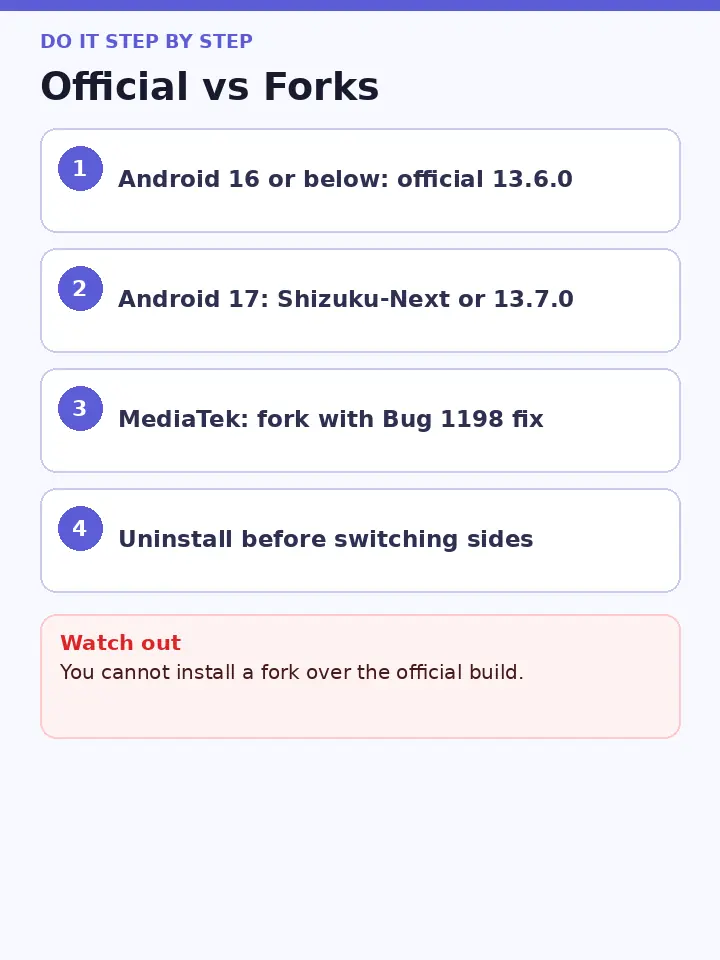
Every fork signs with its own key, so Android refuses to install a fork over the official build, and the reverse. Uninstall the current build first, then install the other. Your apps' authorisations reset, re-approve them after switching. Hashes: the official file SHA-256 and signer are on the SHA-256 page; thedjchi 13.7.0's file SHA-256 is 6ea6dee65d5ddc626b6b75b2c2f67f8cc547fa47d7b437e6892639c37eaffe43.
This is also the safety line. A different signer is not automatically a bad signer, but it is a different trust decision. With the official build you trust RikkaApps; with a fork you trust that fork's developer and their release process. Download forks only from their own GitHub releases pages, check the hash where one is published, and read the safety guide before you switch, not after.
Maintenance: paused, active, and stalled are different things
Three projects, three rhythms. The official repo is not archived, it is simply quiet: last release May 2025, last code push June 2025, and a critical Android 17 issue unanswered. thedjchi shipped the important fixes and then paused, openly. Shizuku-Next ships regularly, 14.0.36 on 16 Nov 2026, 14.0.38-next seen on 23 Nov 2026, and is where new work lands first, betas included.
What does that mean for a normal user? A paused-but-stable fork is not a risk by itself; the code does not expire. An actively developed fork gets fixes faster and occasionally ships a regression first. Pick by your Android version and your tolerance, not by which version number looks biggest, and keep an eye on the updates tracker, which logs every build with its date.
Which one should you install?
Android 16 or below, no MediaTek bug: official 13.6.0, the stable, boring, correct choice. Android 17 or a MediaTek phone: a fork, because the official build cannot do the job there. Between the forks, Shizuku-Next is the actively developed line with auto-pairing; thedjchi 13.7.0 is the calmer, finished build. Shizuku+ stays a curiosity until better sourcing exists, its one advantage, side-by-side install under its own package name, is real but thinly verified.
Deep dives if you want them: the Android 17 guide for the breakage itself, the Shizuku-Next page for the active fork, and the MediaTek fix for bug #1198. And if you are switching builds today, do the boring part first: uninstall, install, re-approve your apps, confirm "Shizuku is running" before you open anything else.
Frequently Asked Questions
Is a Shizuku fork official?+
No. Forks are unofficial community builds of the open-source Shizuku code, made and signed by different developers, thedjchi, the Shizuku-Next maintainer, and the Shizuku+ author. The code being open (Apache-2.0) makes forks legal and normal, but the trust decision is different: with a fork you trust that developer's builds, not RikkaApps. This site labels forks unofficial everywhere they appear.
Can I install a fork over the official build?+
No, the signing key differs, and Android refuses to install an update signed by a different key. Uninstall the official build first, then install the fork; the same applies in reverse. Your supported apps keep their data, but their Shizuku authorisations reset, so open Shizuku after switching, confirm it is running, and re-approve each app when it asks.
Which fork is best for Android 17?+
Shizuku-Next, if you want active development, auto-pairing and the newest fixes, it is the line that ships regularly. thedjchi 13.7.0, if you prefer a stable, finished build whose author has paused maintenance; it was the first fork to fix Android 17. Both fix what official 13.6.0 cannot do there. Shizuku+ is too thinly sourced to recommend.
Are forks safe?+
They are open source, which means the code can be inspected, but you are still trusting a different signer than RikkaApps, and most users cannot audit code themselves. The practical rules: download only from each fork's own GitHub releases page, check the published SHA-256 where one exists, and treat any fork APK hosted anywhere else as untrusted. The safety guide on this site covers the full reasoning.
What is Shizuku+?+
Shizuku+ is a smaller fork (13.7.0.r3349, 18 Nov 2026) whose distinguishing feature is its own package name, so it can install side by side with the official build instead of replacing it. It is verified only by a single secondary source, which is not enough for this site to recommend it. It is listed here for completeness, and labelled unverified wherever it appears.
Will the official build catch up with the forks?+
Nobody outside the project can say. The official repository is not archived, but its last release was May 2025, its last code push June 2025, and the Android 17 issue has had no developer reply since June 2026. If an official 13.7 or 14.0 ships, the updates tracker on this site will log it with its date, until then, forks are the maintained line.
About this guide
Shizuku vs official forks: official 13.6.0 against Shizuku-Next, thedjchi 13.7.0 and Shizuku+, Android support, features, signing keys, maintenance, and which one to install. This guide is part of shizukuapk.pages.dev, an informational resource about Shizuku APK by Xingchen & Rikka (RikkaApps). It does not host the APK file, downloads link to the official GitHub releases page.
Version, size and hash figures are dated 23 Nov 2026, re-check the GitHub releases page before installing.
Related Guides
Fact-Check, Verified 23 Nov 2026
Fact-checked by Editorial Reviewer (Reviewer & Editor), 23 Nov 2026 - Written by Omer Akbar. The claims on this page, versions, dates, hashes and compatibility statements, were checked against the primary sources on our Sources page, following our Fact-Checking Policy and classified under our Editorial Policy (Official / Reported / Rumor). Found an error? Tell us and it will be re-verified and corrected on this page.